
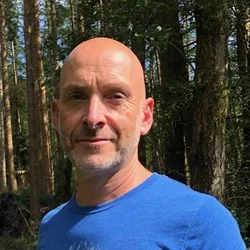
Not long ago, on a walk with a dear friend, she described her experience of perimenopause to me. As she spoke it occurred to me that she wasn’t really describing hormones, and physical changes to her body. She was describing the loss of an identity. The loss of her identity without a clear picture of the woman she would become.
I realised that I knew that feeling, not because I have great insights into menopause but because I have used similar words myself. A few years ago my wife of twenty years suddenly passed away, an event that neither of us were at all prepared for.
We were best friends and business partners, and both devoted to service through our work. We didn’t spare much time to spend with other people, or to pursue separate interests. Aged 55 at the time, I felt cast adrift – I knew that I was changed forever but I had no idea of who I would become. Was there any point to my existence any more, or might I simply fade away?
Periodically life asks us to become someone else
There are many events across our lifetimes that may induce very similar feelings, not only menopause and bereavement. Anything we identity ourselves with leaves us vulnerable to changes, whether they are predictable or not.
Loss of purpose through retirement or redundancy, or children leaving home. Divorce, illness, and simply feeling the effects of ageing. Even something g as outwardly joyful as becoming a parent could mean a significant shift in our sense of self. All of these can lead to us asking; “Who am I now?”
Why this can feel so bewildering
Most of us feel a strong need to belong – to be accepted by our families and the society we live in. Gabor Mate refers to attachment and authenticity as our main needs, and adds that attachment will usually trump authenticity. In other words, our need to belong is greater than our need to be our true selves. Consequently, from childhood, most of us learn how to behave, what is acceptable to the people whom we depend on. We learn to create an identity that keeps us safely attached to those who matter – caregivers, friends, intimate partners, colleagues and bosses.
It is in our nature to become good at the things that we practice a lot, so we become masters of being who we are ‘supposed’ to be. Don Miguel Ruiz refers to this as ‘domestication’ – conforming to the story of the collective instead of living our own story.
So when life takes away a piece of our identity it can be deeply distressing. A fracture to our identity can easily have physical consequences. Perhaps we brace and harden our bodies. My own experience of bereavement left me feeling physically unsafe, as well as emotionally so – activities that had been normal suddenly felt too dangerous. In my work as a movement teacher I noticed an eerily strong correlation between shoulder problems and the ‘empty nest’ feeling of women whose children had left home.
While redundancy or retirement may challenge a man’s sense of his virility, his manhood, doubtless many women feel the menopause to be a clear sign that they are no longer ‘real women’, that they have lost their worth to society (thank goodness that a lot off great work is being done to change these perceptions and to celebrate the ‘grandmother’ stage of women’s lives).
The gift hidden inside the fracture
Instead of being asked to become something different, perhaps these inflection points in our lives are an invitation to stop pretending to be someone we’re not. They may serve as reminders of who we were born to be.
My experience was of being dissolved by bereavement, or melted down. Through the process of grieving I settled on the analogy of the life cycle of a butterfly – I had been living as the caterpillar and grief turned me into a mush of cells. With al lot of help to navigate that landscape I found myself as someone new – a kinder, more compassionate and lighter person emerged. This transformation was greatly helped by experiencing Tantric bodywork, and subsequently training as a practitioner. I had found a new purpose.
Here I believe we need to honour our bodies over our minds. We may give ourselves affirmations, and we may receive them from friends, teachers, even social media posts. We know that we are good people, that we are enough, lovable and beautiful inside and yet we can still hear the contradictory voices. Alongside the feeling of being unsafe mentioned above I was both ashamed and disgusted with myself because my inner critic said I wasn’t grieving properly.
My introduction to Tantric bodywork was by chance, or more likely divine intervention. In my grief the thing that I felt most need for was loving touch. These days I’d say “conscious touch” but I had not heard that phrase at the time. I was regularly offered hugs but they did not meet that need.
I happened on the website of a practitioner while searching for something quite different and immediately booked a session. I went hoping to receive the kind of touch I needed but with no idea or expectation of healing my pain, let alone shifting my fear state.
The very first session that I received was over 7 hours and utterly transforming. Yes, I felt the kind of touch that I’d been craving and, more than that, I had an embodied feeling of being enough. The sense of being constantly unsafe vanished, my inner critic was silenced, and neither returned in the following months.
Since becoming a practitioner of Restorative Tantric bodywork I have seen many of the women I’ve worked with experience something similar – healing not by being told that they are enough but experiencing, over several hours, being accepted exactly as they are.
How does this happen? Together we create a space of steady presence, safety and compassion. Clients feel able to grant themselves permission to simply be, with no masks, and no need to perform. This allows them to “come home” – to meet their most authentic self with love.
Might then life events that ask that question: “Who am I now?” not be about becoming someone new? Instead they can be about remembering the person who existed before life taught us who we should be.
What might seem like an ending carries the possibility of a homecoming.




We use cookies to optimize our website, personalize and measure the effectiveness of advertising and collect statistics on usage.
| Mon | Tue | Wed | Thu | Fri | Sat | Sun |
|---|---|---|---|---|---|---|